
As previously noted, we have now done just about all you can around Niagara Falls, with the exception of the zip wire crossing, a temptation we are managing to resist for some reason. So, we decided it was time to take a look at Buffalo – a town which is undergoing revitalisation, as are many other of the northern USA industrial towns following a long period of stalemate as their industries abandoned them.
The main reason for the original growth of Buffalo was its position on the Great Lakes. It sits on Lake Erie where the Niagara River departs for Lake Ontario. For a long time this position was insignificant as all shipborne cargo to the east coast from central states when down the Mississippi and on a very circuitous route after that. This is obviously in the days before trucking took over a lot of that freight carriage. It used to be that the only way from the Lakes to the Atlantic was via the St. Lawrence seaway – a massive trip involving a lot of inclement water, hence the use of the southerly route. Also, there was the need to bypass the Niagara Falls.
The building of 2 canals changed everything. The Welland Canal bypasses the Falls and allows shipping to travel between Lakes Erie and Ontario, but still after that the access to the East Coast is difficult. The Erie Canal, completed in 1825, linked Lake Erie to Albany on the Hudson River, and therefore provided navigable access to New York city. At 363 miles in length, it was the second longest canal in the world after the Grand Canal in China, at that time.
The primary use for this route was to ship grain from the Mid-West to New York and the east coast. We took a boat tour up the Buffalo River, which was used for boats which had come across Lake Erie to unload and store their cargo prior to it being reloaded onto the shallow draft canal barges required to navigate the Erie Canal.
The Buffalo River is lined with grain silos as a result, creating an amazing industrial vista which includes some of the largest silos in the world. The story is fascinating – originally all the grain had to be unloaded by hand and this took weeks, thus creating a bottleneck for shipping at Buffalo. Due to that the early success of the canal was reduced as many shippers reverted to the southerly route. That was until the grain elevator was invented in Buffalo by Joseph Dart, a merchant, and Robert Dunbar, an engineer, in 1842 and 1843. This used steam power to mechanically unload the ships in hours rather than weeks, which in turn revitalised the route and the city.
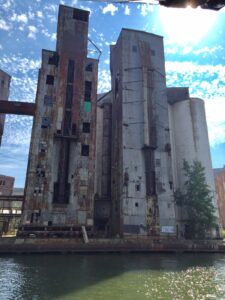
The grain elevator part.
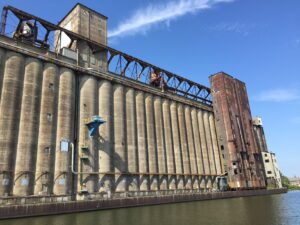
Not the largest silo building!
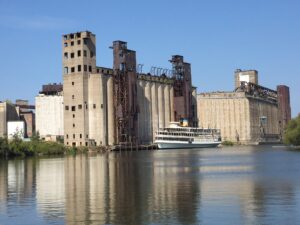
More silos, plus an old ferry being restored – it used to carry over 3000 passengers, but will be licensed for less than half that this time!
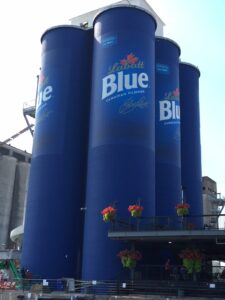
Labatt’s Blue – obviously!
More silos, plus an old ferry being restored – it used to carry over 3000 passengers, but will be licensed for less than half that this time!
OK, history lesson over, though there is a lot more to it than I have mentioned, of course. I think I should share the great anecdote told to us on the trip. I forget all the details – name of ship etc, it was in the 50s, and the story is a good one. At our furthest point up the river on this trip, we were told about a ship which was moored overnight near the most upriver grain silo, which means past a turning area used by those ships wanting to avoid the use of a tug to leave the river.
This ship was unattended, and somehow broke its moorings. As it’s a river, not a canal, there is a current, and it set off down the river towards Lake Erie, swinging through the turning area and carrying on down, gathering pace. It was night, nobody was paying attention. Somewhere along the line it hit a second ship and that too then broke its moorings. That was seen by an onlooker, he went to find the guy responsible for watching that second boat, to find that the guy there had left his post to watch TV with his girlfriend – information provided by his wife!
The 2 ships carried on down the river, towards a bridge which needs to be raised to allow them underneath. The alarm had now been raised, though still at a low level. Someone was despatched to warn the bridge operator to raise the bridge, but found he wasn’t there, but had trotted off to the local bar for a beer or two. When finally alerted he ran back and operated the bridge, but couldn’t raise it high enough in time. The 2 ships crashed into it and pretty much destroyed it.
Beer and TV have a lot to answer for….
We followed the route of the errant vessels down the river and onto Lake Erie – our second of the Great Lakes this trip.
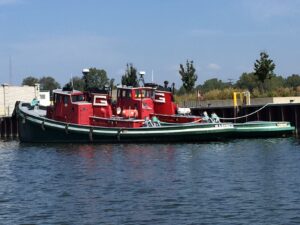
Tugs near the mouth of the Buffalo River
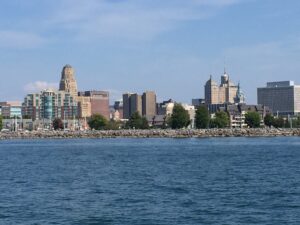
View of downtown Buffalo from Lake Erie
A beautiful and very hot day – we walked from the dock back alongside the river to cross over and have lunch at the building with the big blue painted Labatts silos alongside. Part of the city regeneration is to use these buildings, this one has a restaurant, rollerskating arena and a climbing wall. Plus, an area of broken concrete walls nicknamed Beerhenge!

Beerhenge – Cheers!